The book, the study, the papers and the idea
Research
People finish the task and still can’t say what happened. I study why, and how to measure it.
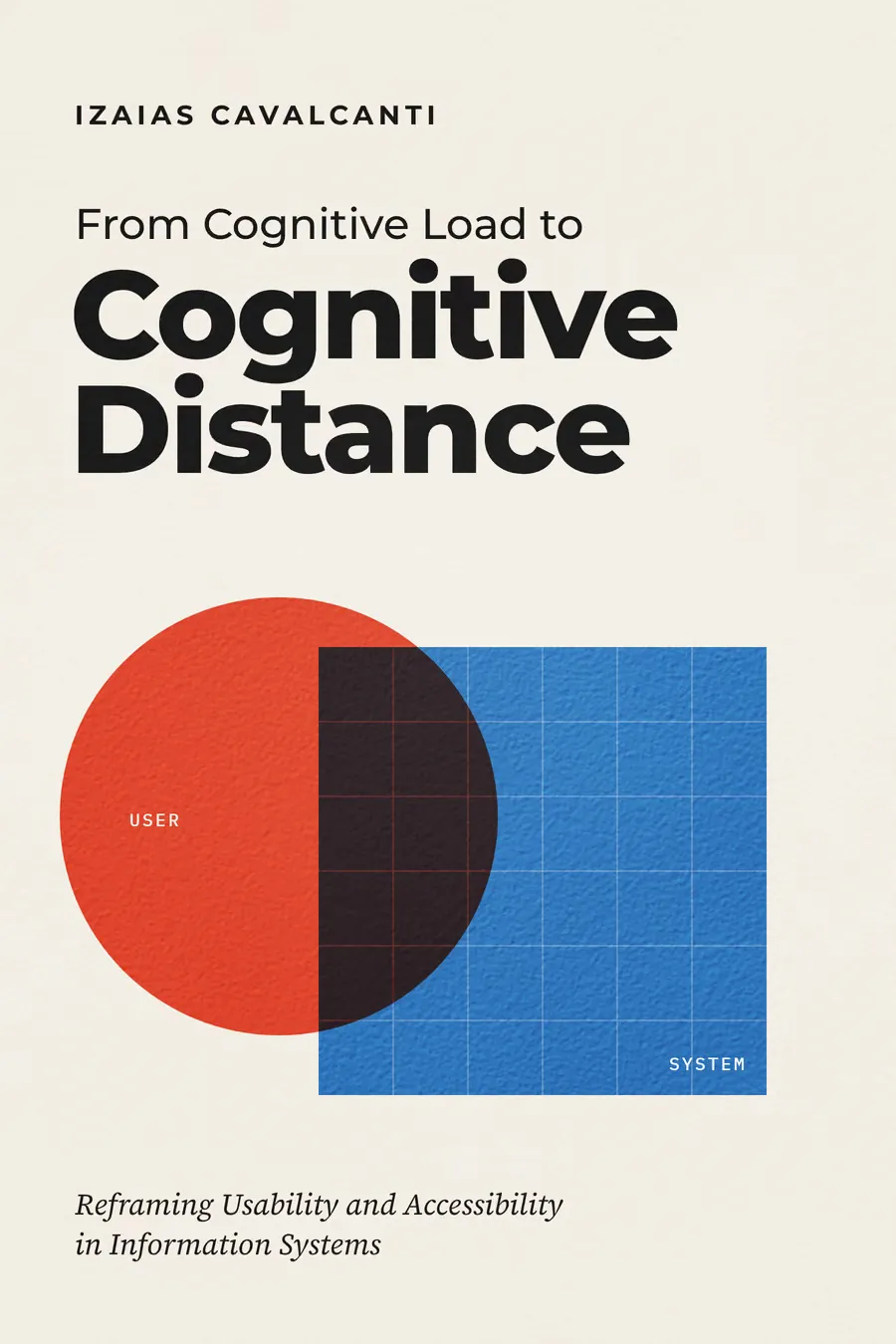
The book
From Cognitive Load to Cognitive Distance
I wrote it for anyone who builds or runs a system people have to understand: designers, researchers, product leaders and public servants. 118 pagesI wrote it and published it myself. It’s free to read online or as a PDF.Read the book, 13 chaptersThe table of contents is online, and so is every chapter behind it.The table of contents, 66 cited worksEvery work the book leans on is listed on its references page, open to anyone.The references. Self published, and free to read.
Paperback and Kindle are coming.
The study
Everyday Services Study
An open experiment I designed and built. You do three everyday tasks online, a bank transfer, a medical appointment and a licence renewal, in English, Spanish or Portuguese.A bank transfer, a medical appointment and a driver’s licence renewal, in English, Spanish or Portuguese. When a small pilot surprised me, I changed the study rather than the story.Take the study Everyone sees the same screens. Only the wording changes, plain or institutional.
In the pilot (descriptive only), the plain language arm scored about 1 on the CDI and the institutional arm about 38. Inferential results are pending peer review.These come from a small pilot with friends and family. They describe what happened there and prove nothing yet, which is why the full study exists.Take the study
Fifteen minutes. Three everyday tasks. Help measure the distance.
Papers
I write them alone, about one a month since late 2025. Each says plainly where it stands.
- 2026Cognitive Distance in Information Systems: From Concept to Measurement to Field EvidenceIn peer review
- 2026Users Complete Tasks but Still Cannot Explain Why: Measuring Cognitive Distance in Information SystemsPreprint
- 2026Cognitive Distance in Document Submission Systems: Why Users Struggle with Simple Digital TasksPreprint
- 2026Measuring Cognitive Distance in Information Systems: Toward an Operational FrameworkPreprint
The idea
A name for what I keep seeing: cognitive distance.
It’s the gap between how a system works and how people think it works. The idea page explains it in plain words first, with a map, a way to measure it and the rules I took from it.
Where else to find it
- Google Scholar
- ResearchGate (as Izaias Cavalcanti, USP EACH)
- Preprint DOI
I took graduate courses in HCI and digital accessibility at the University of São Paulo in 2025.